Port Washington
[Introduction] [Quick tour and orientation] [Statistics] [Transportation systems] [Full tour] [Simulator tricks]
Introduction
I've always loved model railroads. I can spend ages watching -- not just the movements of the trains, but the construction of a miniature city, with buildings, landscapes, citizens, and so forth. Creative world-building has always appealed to me, whether model railroads or Tolkien's legendarium. I've never built a physical model railroad, but there are digital equivalents of building artificial worlds.
SimCity, and especially its successor Sim City 2000, were significant parts of my childhood. I spent countless hours designing all sorts of cities, and learned a lot about urban planning in the process. In fact, in graduate school for civil engineering I heard the phrase "trip generation", I recognized that term from Nick Dargahi's excellent strategy guides -- Maxis used professional reference material to give its simulator vraisemblance. It's even possible that these games led me to the current career track; or at least planted some seeds that germinated later on. I was fascinated by these software "toys", as Maxis called them -- unlike a game, which has a specific objective, a toy can be used for many different purposes and is open to imagination. Tennis or soccer is a game; a ball is a toy. Maxis put an incredible amount of effort into designing this toy. As someone who now professionally designs large-scale urban simulation software, trying to balance realism with computational efficiency (especially given 1994 hardware) and making it as fun as Maxis did, is an incredible feat.
Port Washington is an effort to push SimCity 2000 as far as it can go, and even beyond some of its limits. Unlike later entries in the franchise, in SimCity 2000 cities are a fixed size of 256x256 tiles, meant to represent roughly 25 square miles in reality. This is a reasonable amount of space, but major metropolitan areas occupy more territory, and attempts to design "real" feeling cities always felt cramped. Port Washington consists of 81 cities, arranged in a 9x9 grid that fits together seamlessly, to form a major city, its suburbs, and rural surroundings. In total, there are roughly 2 million residents, 178 major power plants, and over 4500 water pumps. There are 219 schools, 135 hospitals, and 123 fire stations. I used the space to explore larger districts: major university campuses and medical centers, larger military bases, and so on.
I've worked on this city on and off for about 20 years, starting when I was in college. I built one city, then got the idea to expand it by adding a second adjacent city and matching up the tiles along the boundary. After building the second city, I stitched together screenshots of the two using MS Paint. When I saw them fit seamlessly together, I was hooked and sketched out a 3x3 city grid. A few years later, while bored on a flight, I sketched out an expanded version which is more or less how the city unfolded. I had no idea how long it would take to complete, but as I had time here and there I filled out each city in the grid, making some minor changes along the way. A few years ago I became aware of Dale Floer's successes at deciphering the binary file format, and his Thomnar city which is of a similar character (a 5x5 grid). He supplied a Python library for working with city files directly, which I found extremely useful. For the last decade I've been running my original SimCity 2000 executable on Linux under WINE, but I could never get the Urban Renewal Kit to work correctly, and Dale's code was a lifesaver when I needed to tweak a few things in the cities. For the most part the cities developed using the simulator itself; I tried to keep this direct editing to a minimum.
So, what kind of city is Port Washington? When I was a teenager, most of the cities I built had one of two goals: trying to get the highest population I could, or building hedonistic "paradise" cities. If you are familiar with Dargahi's Power, Politics, and Planning, and the cities he describes in Chapter 11, think of MaxiANC or Calebopolis as cities of these type. The chapter profiled some other cities as well: the perfectly symmetrical Mattropolis, and the philosophical Harsh. But as I've grown older, the city that stuck with me the most was the one that was the least planned, Tari's Kingdom. I'm struck by these lines:
"Tari's Kingdom is the least planned, least organized, and most realistic [of the cities in the chapter]. It grew, changed, and sprawled. Areas were redeveloped. Projects were started and stopped. There are parts of the city that are in great shape, and there are other parts that you wouldn't want to visit late at night without an armed escort."
Real cities have an organic character about them, and I wanted Port Washington to have that feel. Perhaps not parts you wouldn't want to visit without an armed escort, but certainly some grittier areas that aren't all glitz. I wanted to give the sense of a very loose plan -- not just a collection of random cities -- but not overly constraining either. I also wanted to explore the bounds of the simulation, and at one point I decided that the city would include four of every tile somewhere within its bounds, except for the arcologies, as described below. Furthermore, I tried to find ways to incorporate aspects of different cities or regions where I've lived or visited.
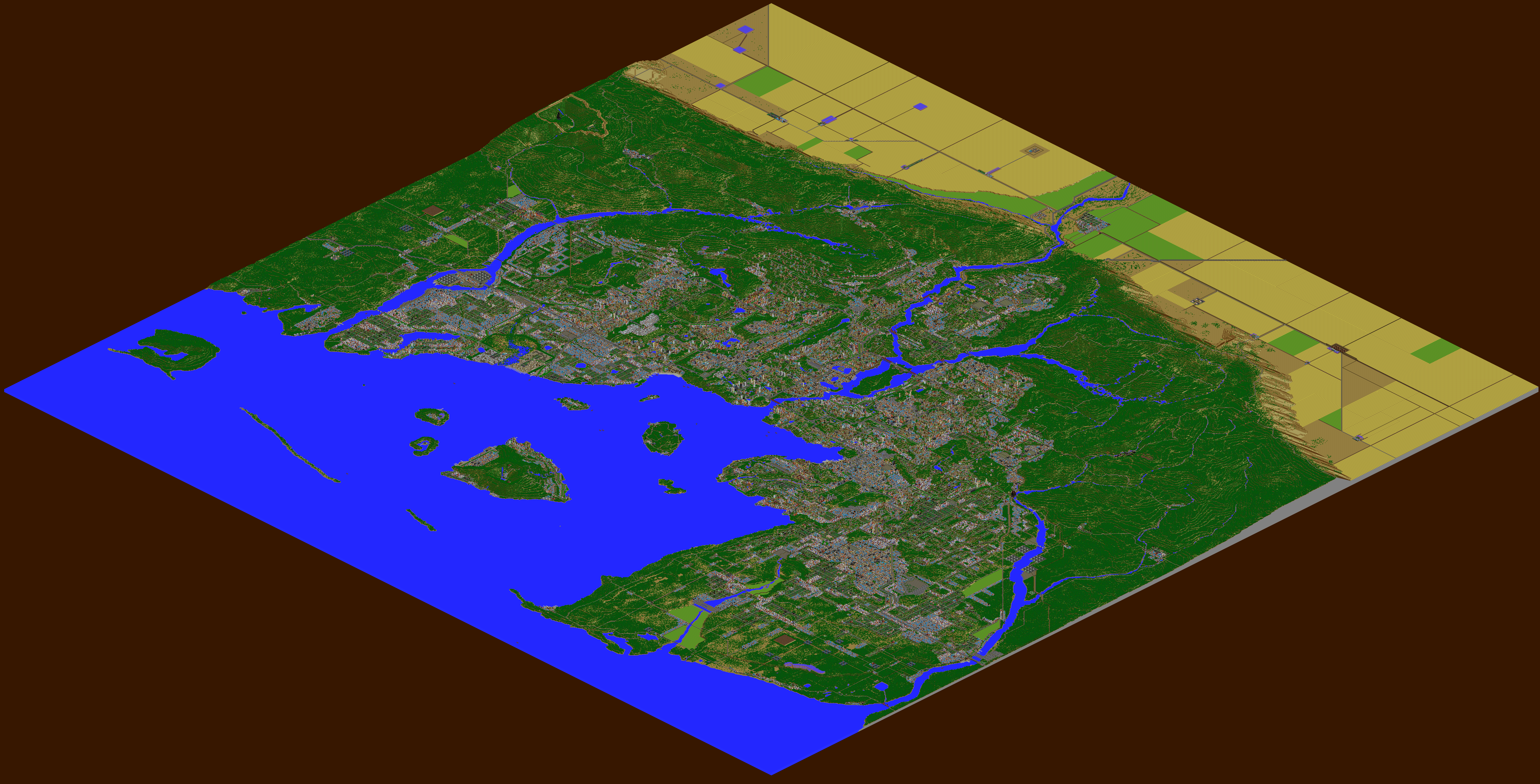
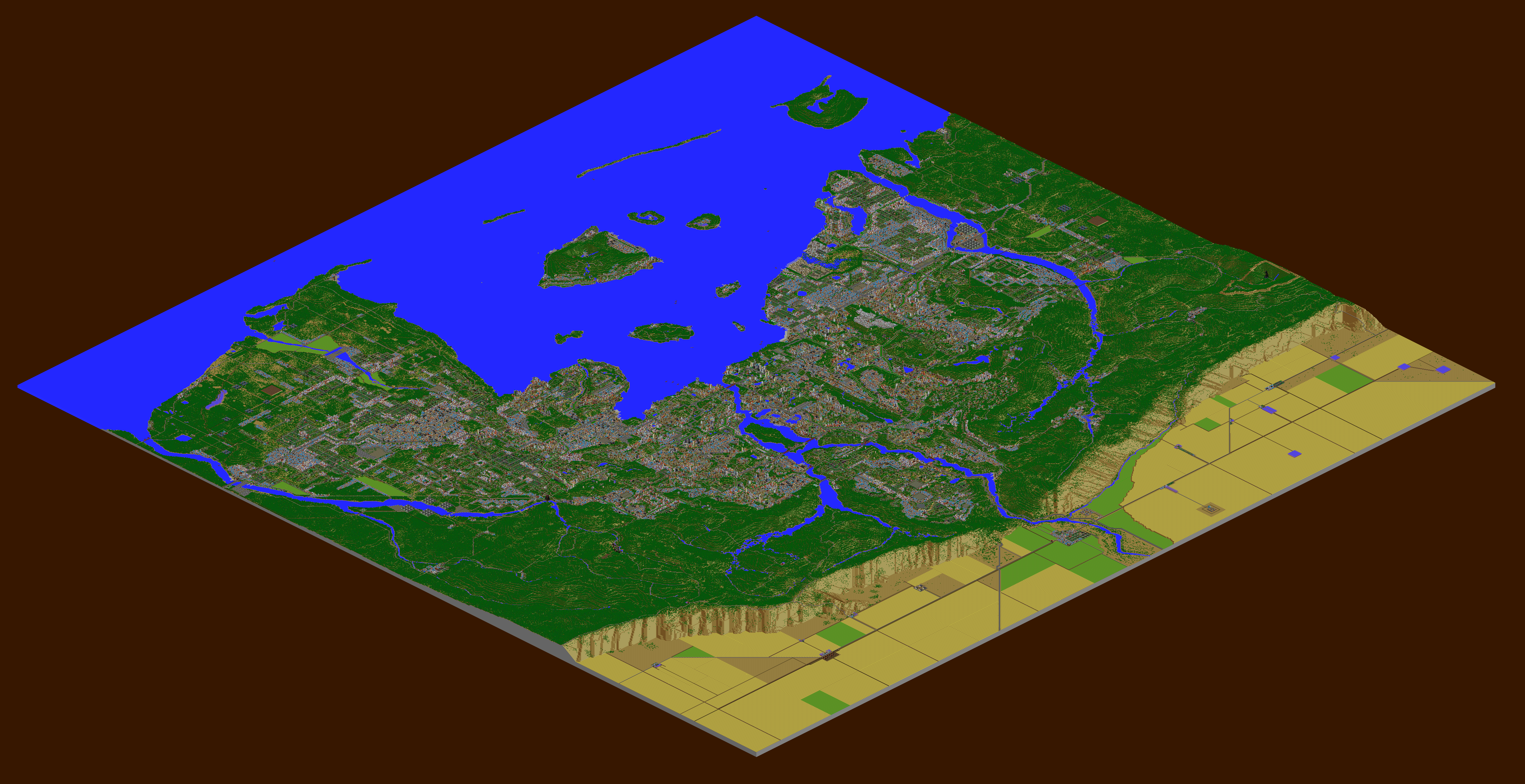
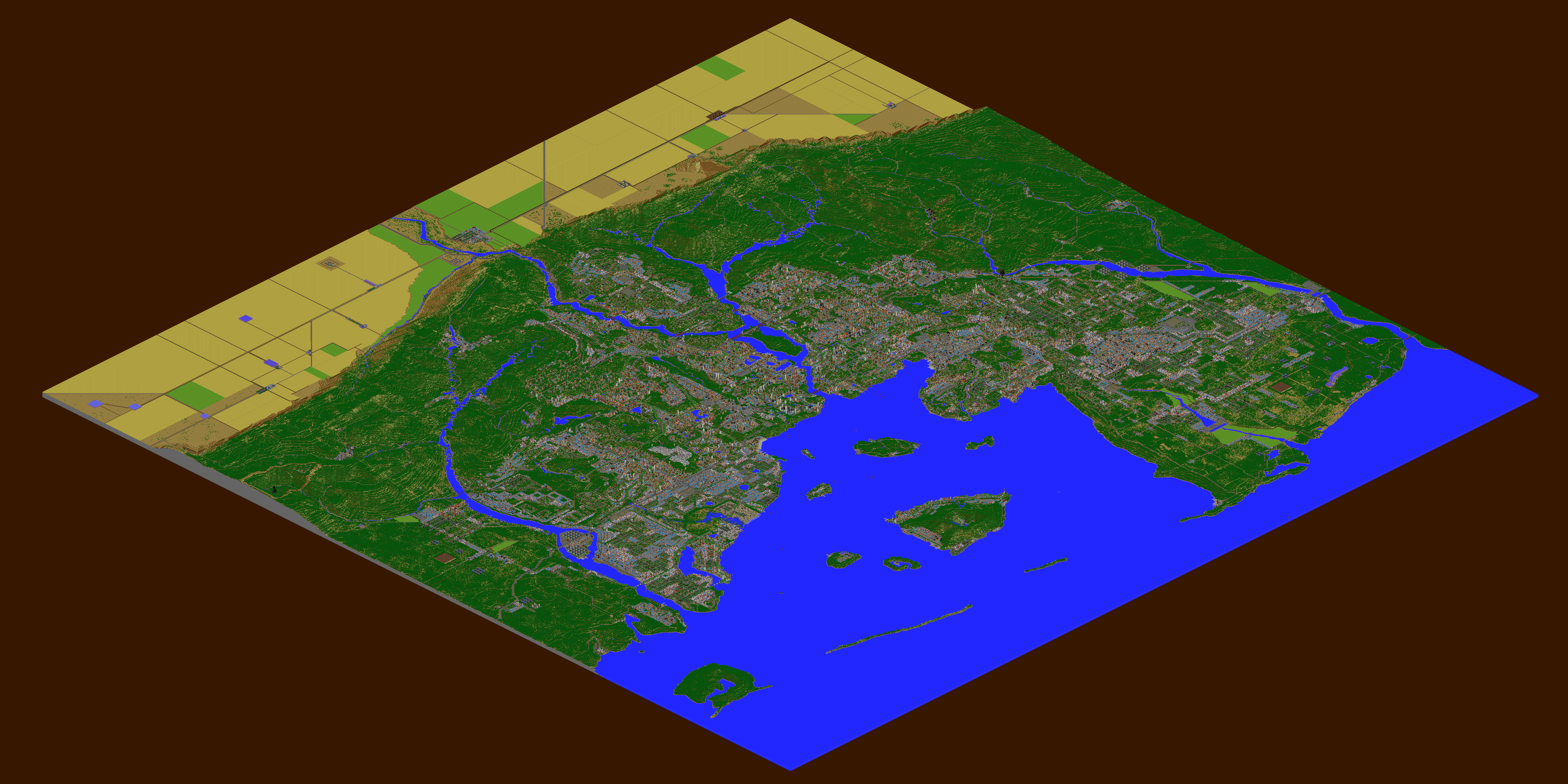
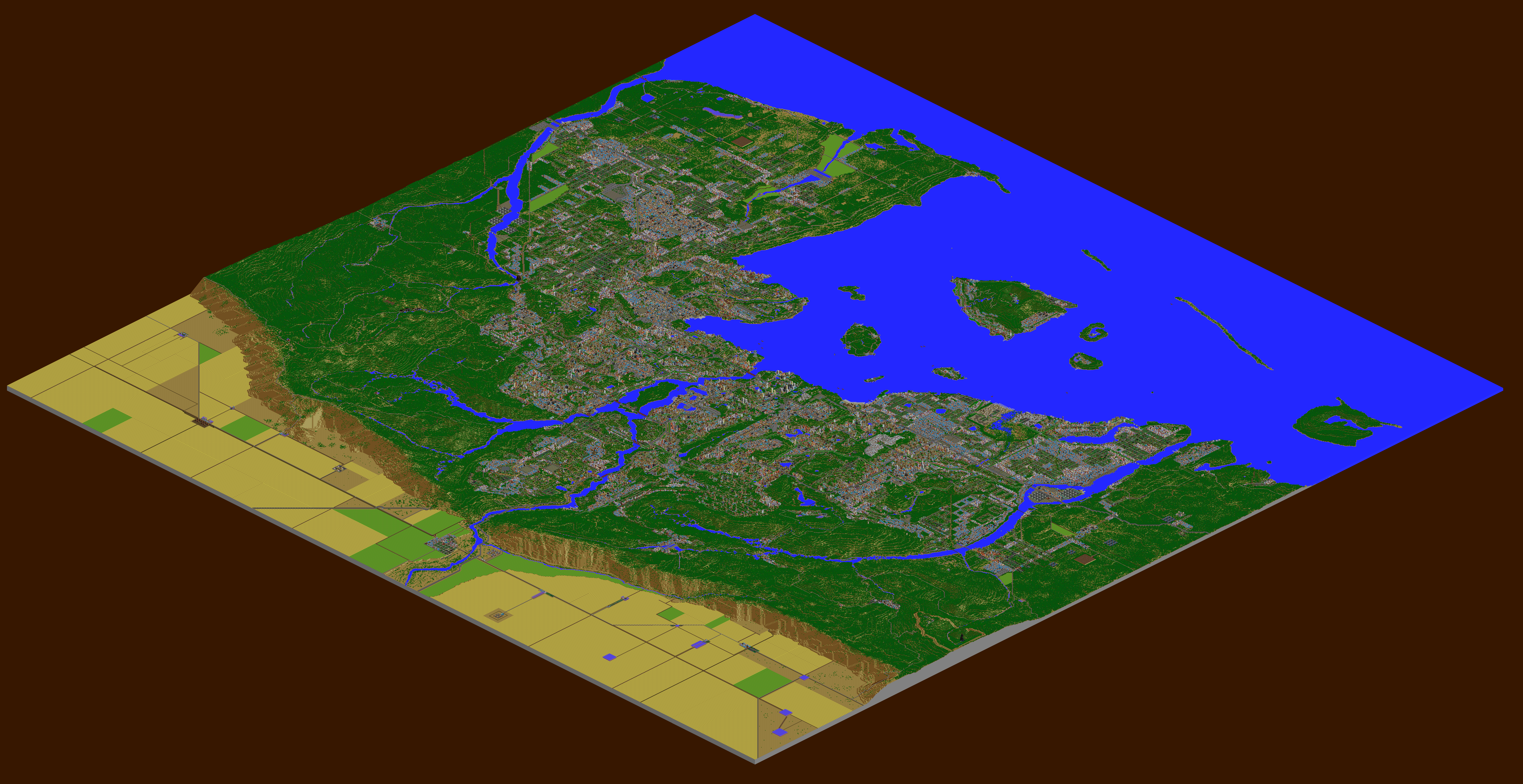
This site documents some of what I've done and what I consider the highlights of the city. But I recommend you scroll around for yourself and take a look! I've stitched together full-resolution images of the component cities and posted them as click-and-drag maps on EasyZoom:
- Looking northeast (recommended)
- Looking northwest
- Looking southeast
- Looking southwest
Quick Tour and Orientation
Port Washington is a coastal city located in the US Pacific Northwest. The geography does not exactly correspond to any location, but is in some ways a compressed version of western Washington state, if a city were located at the mouth of a medium-sized river. Aberdeen would have the closest real-world resemblance. There is open water to the west, and a mountain range to the east. The climate east of the mountains is much drier, due to the rain shadow effect. West of the mountains, the climate is wet, and there are rivers and streams of varying size.
The city has a dense urban core, with suburban developments to the north and south. Further north and south are a number of rural communities. There are rural communities in the mountains, and to the east. There is a national park in the southern part of the mountain range.
The recent history of the city can be seen through the four arcologies. Arcologies are the most iconic buildings in SimCity 2000. They are only available as a late-game reward, after you've built a city with a population of 120,000, and after the game year advances to a sufficiently futuristic year.
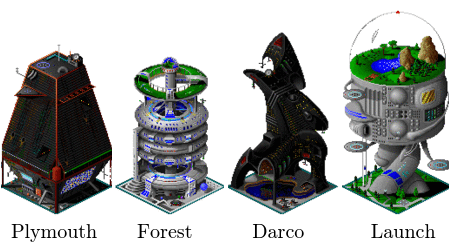
Arcologies are the most expensive buildings, they house enormous populations -- a whole city's population in one building -- and have striking architecture, all of which makes them tremendously cool. As a teenager, I would build cities with dozens and dozens of arcologies, as many as the simulator would allow. As an adult, I've realized that even a single arcology would monumentally change a city: economically, demographically, culturally, technologically, and in many other ways.
I wanted to make Port Washington feel real, which means that a hundred Launch Arcos is right out. Instead, I chose to build one of each of the four types of arcologies, my sole exception to my rule of including at least four of each building and infrastructure type. Here are the four arcologies, along with a bit of story I've added to give a sense of the city. You can click any image to open it directly, making it easier to zoom and pan.
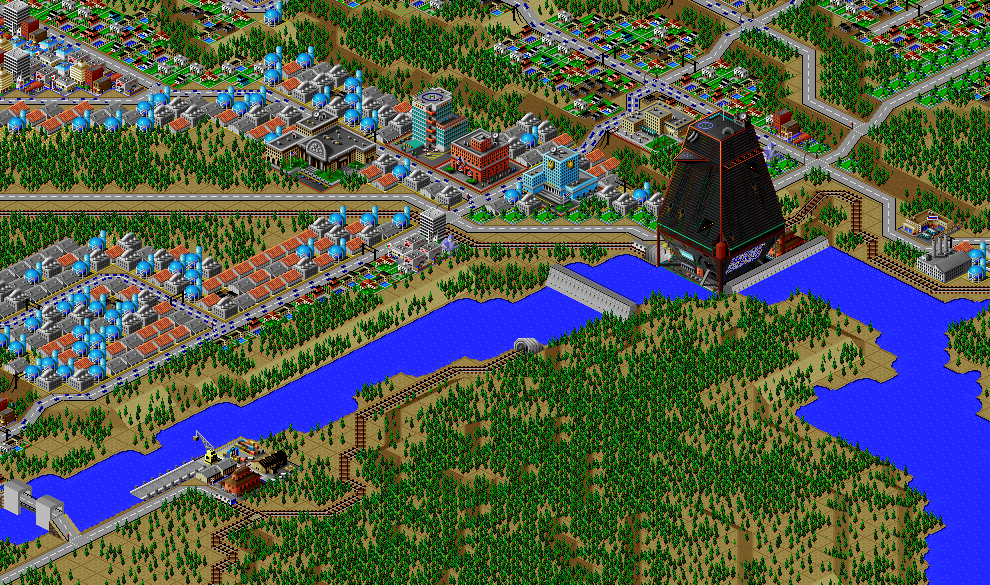
- Plymouth was the first arcology constructed.
It's ugly and industrial, and was designed with manufacturing in mind.
It wasn't a popular building when constructed, and it's still seen as an eyesore today.
But it had an undeniable effect on the city economy, revitalizing Port Washington's manufacturing sector.
- Forest was built roughly a decade later, funded largely from the profits Plymouth created.
Whereas Plymouth was built for industry, Forest was built as a monument to sustainable development.
Designed as a self-contained, fully sustainable, ultra-resilient city-within-a-city, Forest did much to rehabilitate the image of arcology technology.
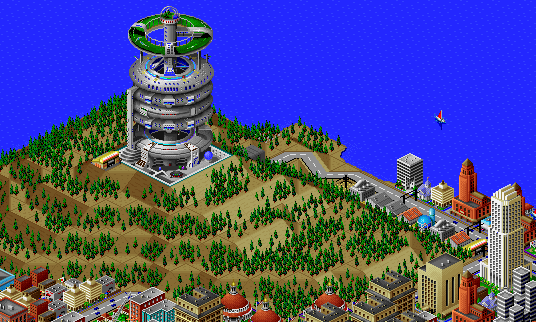
- DARCO was built next, as a confidential project funded by the Department of Defense.
Hidden in the mountains, the Defense Arcology Resilient Command Outpost is a hardened facility providing reundant operations even in the event of nuclear war or other massive disaster.
The vast majority of residents in the city have no idea that it exists.
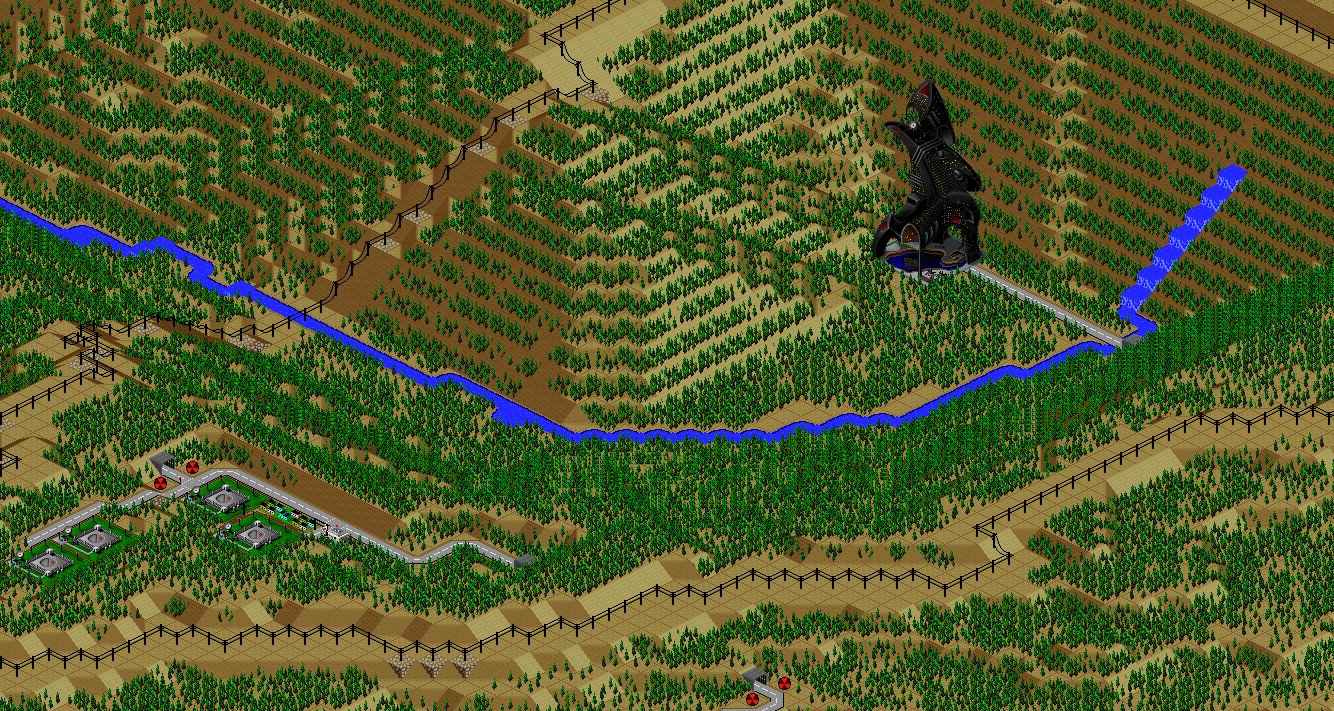
- Launch is another secret project, built in conjunction with DARCO.
Even the military is unaware of this project; rumors are that much of the funding from Launch was illicitly diverted from the DARCO project.
Launch is hidden on an island in the sea, and buried deep underground.
(You're seeing a cutaway view of the secret cavern.)
Nobody knows what kinds of radical technologies are being tested here...
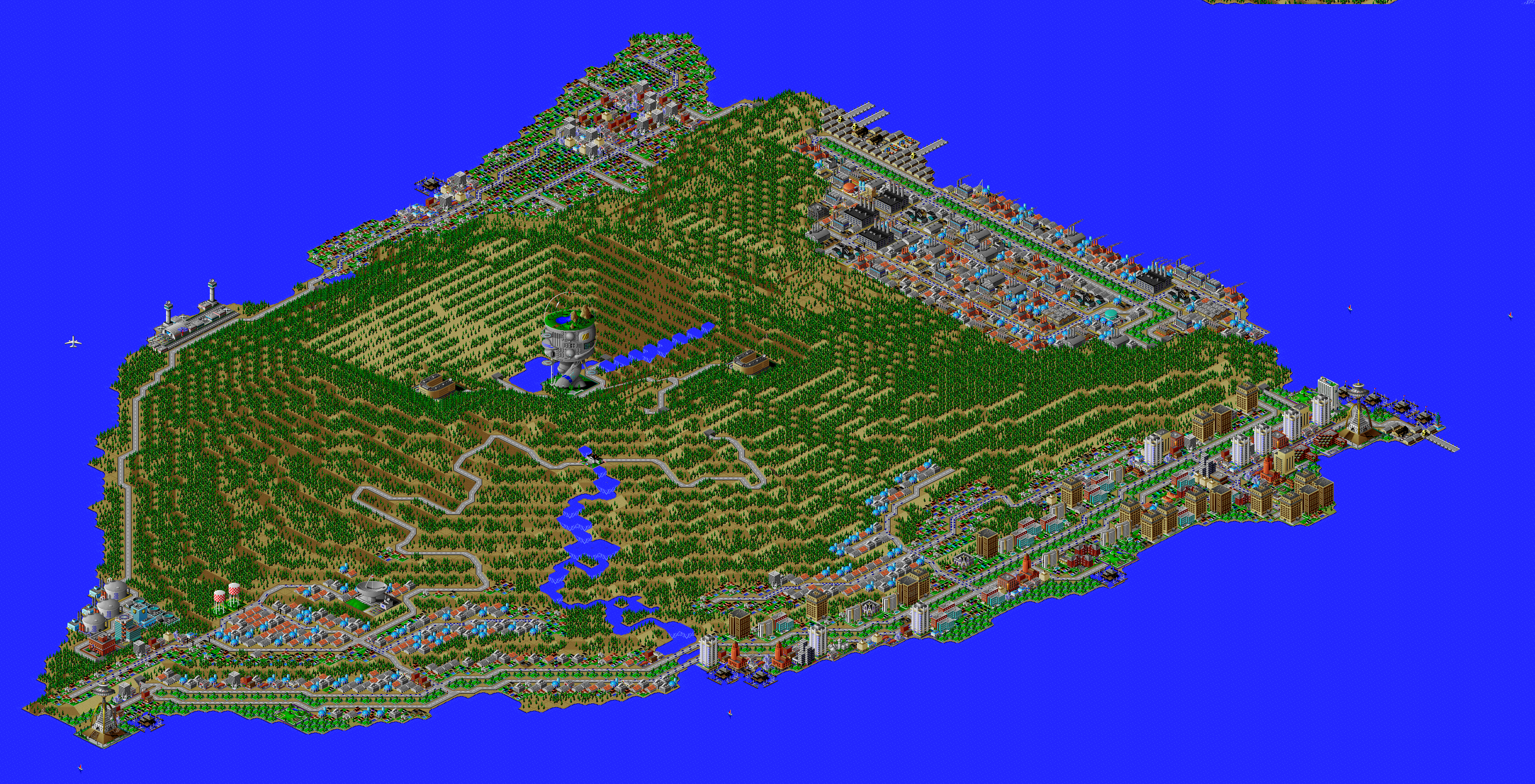
The Neptune Conglomerate is heavily involved in arcology construction. Heavily diversified, this corporation is part manufacturing firm, part tech giant, part retailer, part financial services, and part of most everything else in the city economy. The true owners of the Conglomerate are only partially known, but they are rumored to live in luxurious mansions scattered around the city.
Want to see more? Check out the full tour and see some simulator tricks.
Statistics
Here is a summary table of statistics for the city; this file is a full inventory of building and sprites.
| Population | 2,074,636 |
| Population split | 49% residential, 21% commercial, 30% industrial |
| Power generation capacity (*) | 85,680 MW |
| Power consumed | 55,878 MW |
| Power plants | Coal: 4
Oil: 4 Gas: 4 Nuclear: 76 Solar: 68 Wind: 1039 Microwave: 14 Fusion: 8 |
| Water pumping capacity | 167 Mgal/mo |
| Water consumed | 108 Mgal/mo |
| Water infrastructure | Water pump: 4524
Water tower: 115 Water treatment: 93 Desalinization: 12 |
| Transportation infrastructure | Tunnel: 88
Bus depot: 133 Rail depot: 54 Subway station: 125 |
| Education system | School: 219
Library: 171 Museum: 17 College: 33 |
| City services | Police station: 293
Fire station: 123 Hospital: 135 Prison: 8 |
| Recreation | Small park: 4370
Big park: 106 Zoo: 19 Stadium: 12 Marina: 100 |
| Rewards | Mayor's house: 4
City hall: 4 (**) Statue: 8 (can you find them all?) Braun Llama Dome: 4 Arcologies: 1 of each type |
(*) Excludes hydroelectric plants, see "simulator tricks above."
(**) Port Washington; Kwalhioqua; Hillchurch; Solana
Neighborhoods
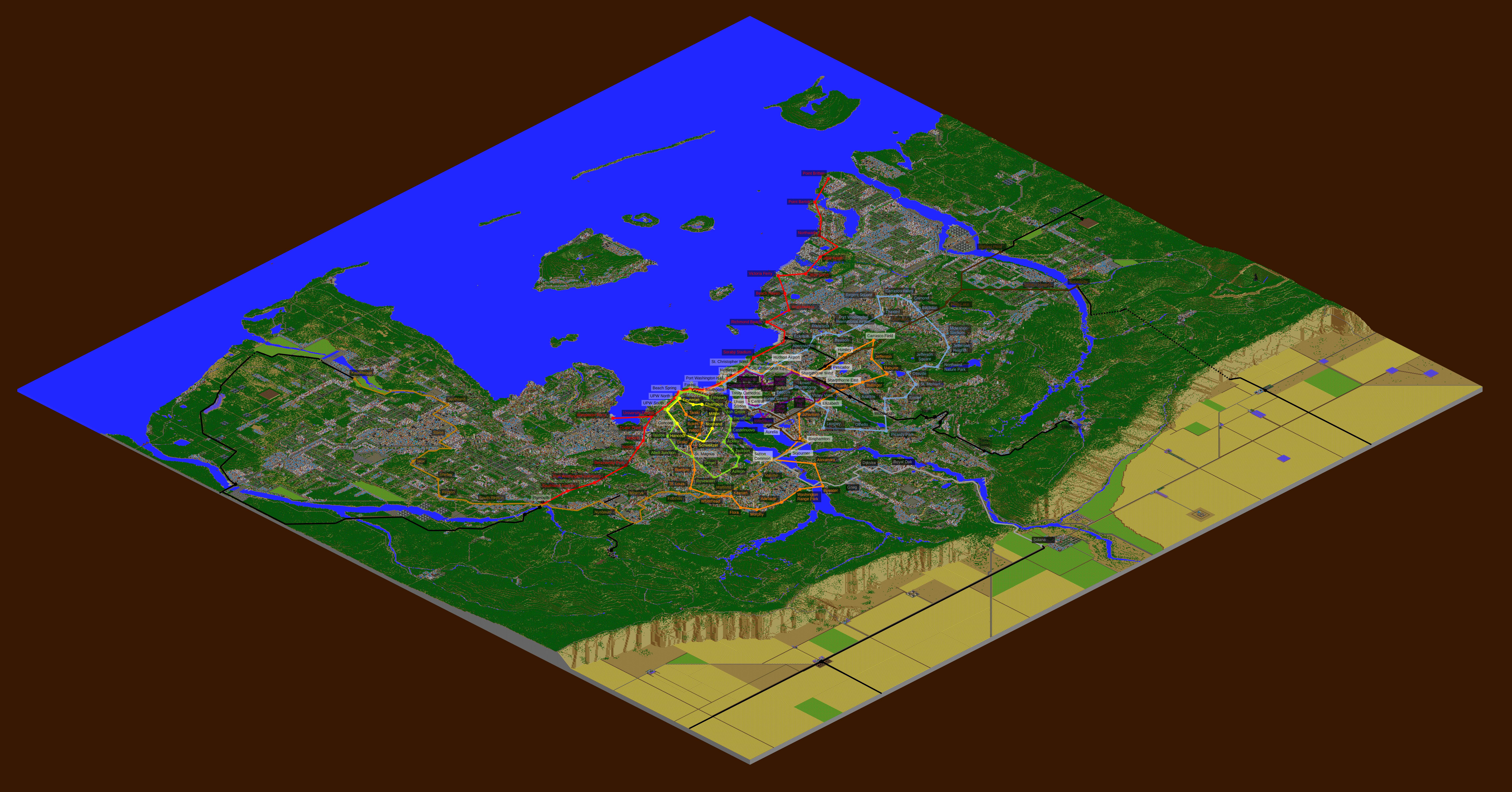
Click to expand. The black lines show city limits; the suburbs surrounding Port Washington are indicated with a color coding in the neighborhood names.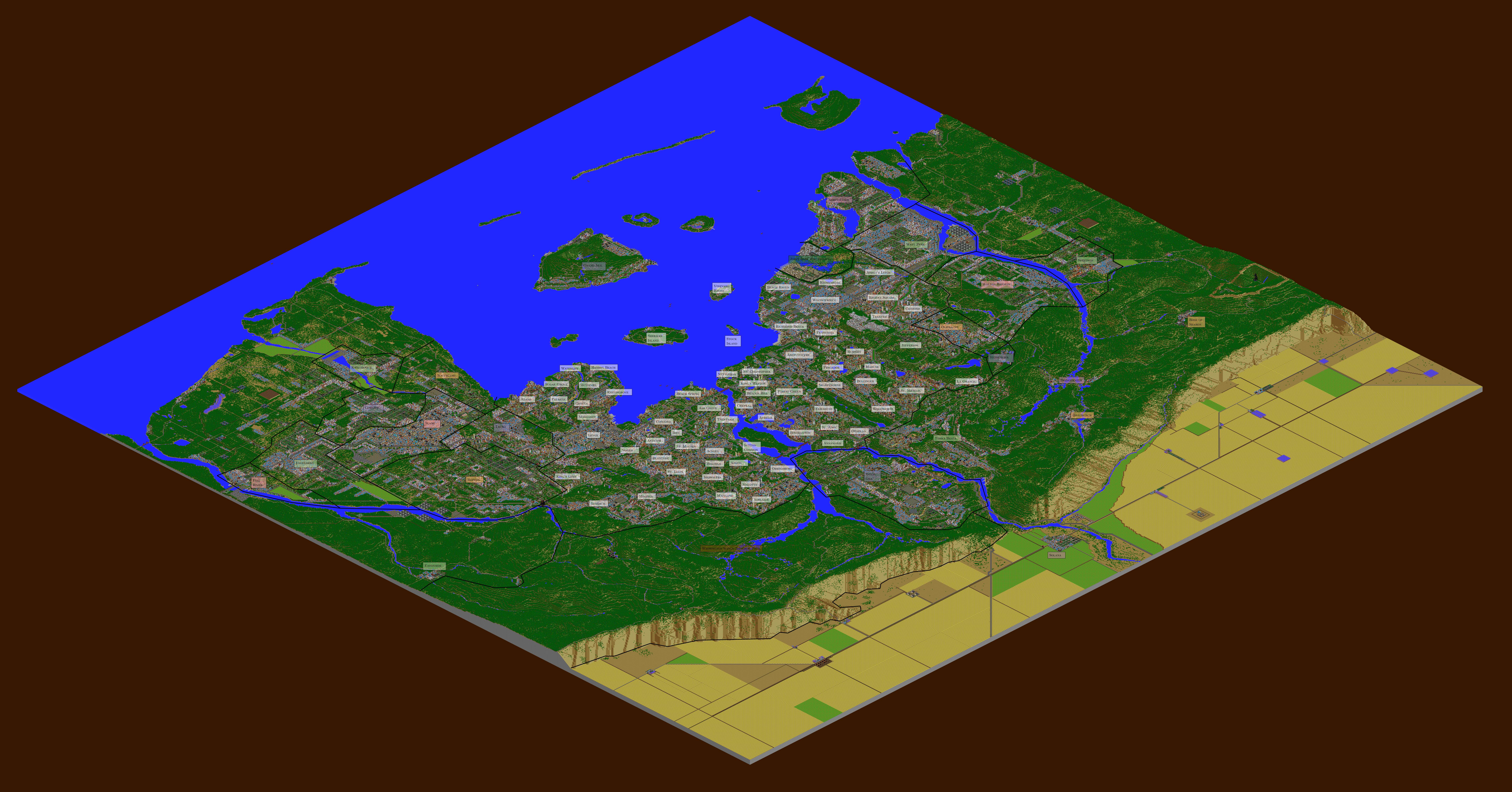
Transportation
Port Washington has a multimodal transportation network.
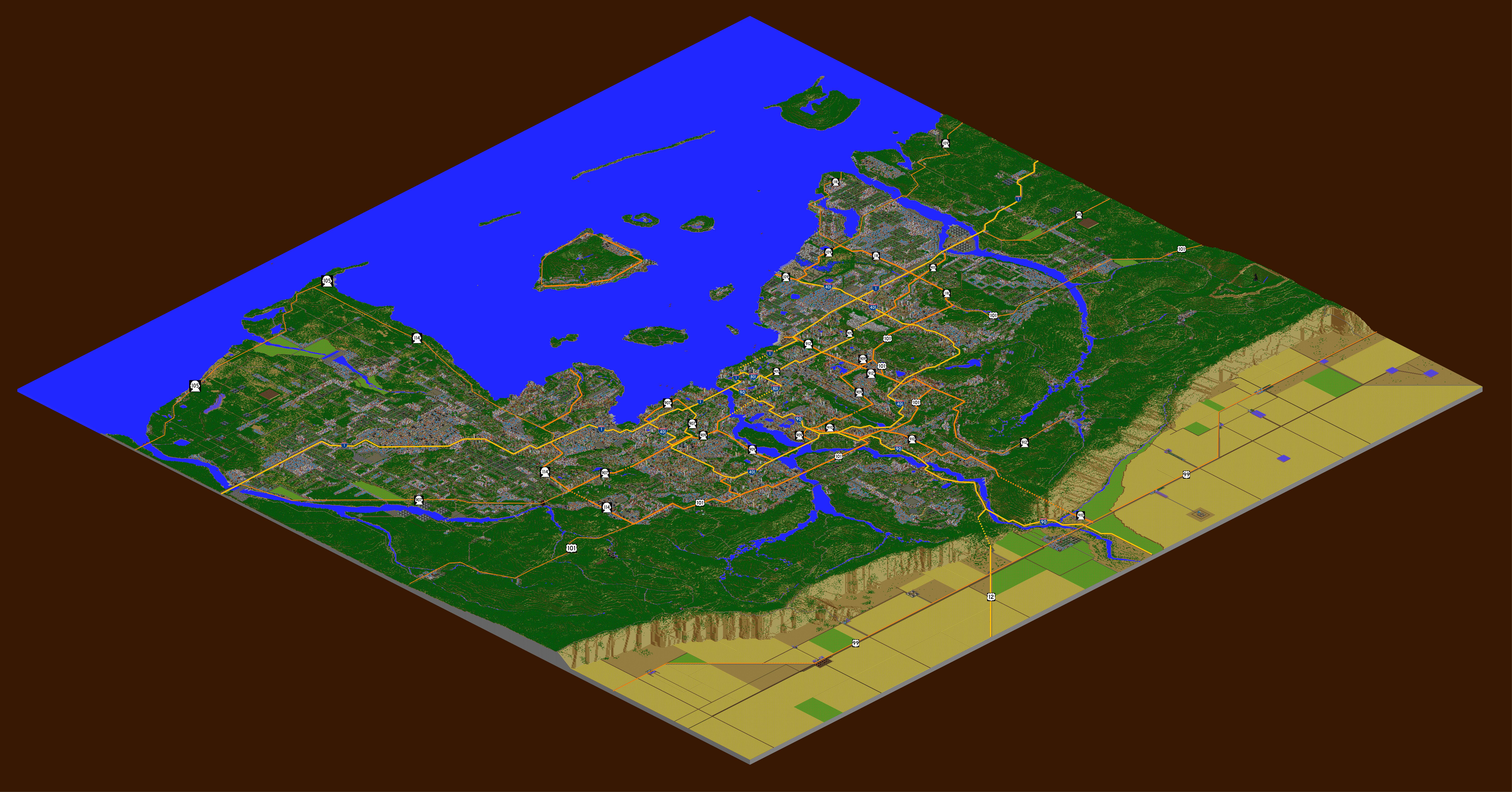
The figures below show the highway and rail systems.
In the rail map, the gold, silver, and brown lines are (heavy) commuter rail, and black is freight rail.
The other colored lines are subway.
The red line (running from Plymouth in the south to Point Britten in the north) has the heaviest ridership.
Click on either image to open a full-sized map.